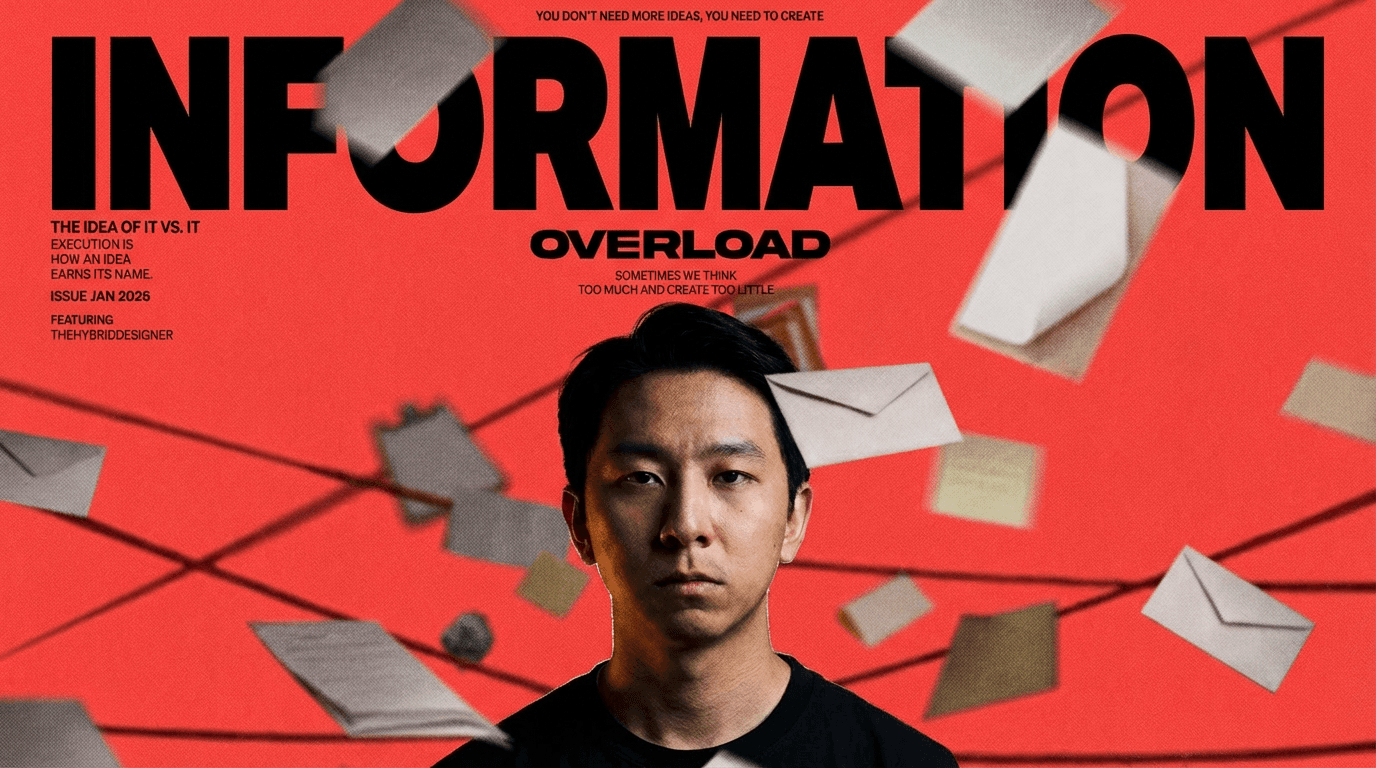
Welcome back to Venture Logbook. While AI generates more content than ever, our attention span stays stubbornly fixed. Today in Trend Spotlight, we examine the attention crisis hitting investors and founders as information overload reaches a breaking point. In Startup Unboxed, we grab coffee with a Gen Z founder who is building a notification filter app to escape the noise. We'll also unpack "Token" in our Tech Dictionary, the puzzle piece that foundation models use to understand language, all in a 6-minute read.
Trend Spotlight
The phrase "Attention is All You Need" isn't just an AI milestone; it's a watershed moment for how humans filter signal vs. noise. As an early-stage investor, I am at the center of the information flow. News, social media, calls, emails, DMs from founders. These bombard me constantly. I believe every investor and founder faces this predicament.
Recently, I've noticed many well-known researchers and engineers in Bay Area posting about their resignations on X. While resignations are common, what's striking is that many cite mental health issues. This isn't just happening in big tech; startup founders are feeling it too. Many say they can't keep up with the tech iterations like RAG and MCP. Just when you learn one thing, something new comes out.
While the input end is fragmented, the output channels have also increased. Founders need to distribute product launch news across multiple channels, manage founder communication on social media, even using reel short videos.
Let's take a look at the numbers.
Within a year of ChatGPT's launch, AI-generated articles made up roughly 39 % of newly published web content, and by November 2024 the volume of AI-written pieces had already surpassed that of human-written articles.
In the workplace, the Microsoft 2024 Work Trend Index shows that 68 % of respondents struggle to keep up with the pace and volume of work, 46 % report feeling burned out, and employees spend about 60 % of their time on email, chat, and meetings, leaving only 40 % for actual production or deep thinking.
Steve Jobs' classic principle on signal-to-noise resonates here. He was a tireless champion of focus, famously saying that true focus isn't saying yes to the idea in front of you, but saying no to a thousand other ideas. Apple notes that deciding what not to build, often more important than deciding what to build, was a core part of his thinking.
I remember asking founders which market they want to target. Of course, aiming for a market that could grow to a billion-dollar size is attractive, and every investor loves it. But that signal can become distorted if you let even a little bit of external "noise" creep in. That noise can come from the market, investors, advisors, mentors, and so on. In this age of grand navigation, it's easy to get lost.
However, the frustrating reality is that many people become addicted to noise. They sink 18 hours a day into their "cool" startup, treating the grind as proof of effort and success. I've been there myself. At the same time, I'm building my own information filter system. Since attention is the only resource we truly have, we're essentially engineering an attention-allocation system.
I also love asking founders: "What's your North Star metric?" That North Star keeps you on course, Oh, it's ok, occasional detours for exploration are fine, but you need a system that flags when you drift.
Could a filter economy, where attention-filtering platforms dominate over traditional advertising, be the next big market?
Startup Unboxed #6
This week, I had a coffee chat with a Gen Z founder. He just applied to YC's new batch (didn't get in) and is now looking for his next opportunity. To me, he's the perfect embodiment of what we discussed in the last paragraph.
Gen Z is stuck in a weird paradox. On one hand, they're incredibly fortunate, I keep hearing that high schoolers are already using ChatGPT. We didn't have that luxury; we were ten years into our careers before tools this powerful existed.
Yet they're also the generation hit hardest by the attention economy. It seems like unless you're blowing up on social media, unless you're going viral with ragebait, you're not really successful. Not a real founder, anyway.
Twenty minutes in, he'd already pitched me on countless directions. I'll admit, I was a bit lost. But I understand, after all, he's only in his second year of college.
He's smart, no question, CS and math come naturally to him. But as we all know, even the smartest builders struggle to make something people actually want.
I pushed him to pick one product and go deep. Then he brings up this notification filter app he's building. Wow, talk about perfect timing while I'm writing this piece. I told him I genuinely love it, and unlike his other side projects, I'd actually use this one.
I believe we'll see more of these apps for people who want to protect their energy and attention, who don't want to get "attacked" by ads or news consumption. This kind of application will emerge across different platforms.
🖌 Startup Unboxed is a series where I meet startups, journal the takeaways, and share my thoughts.
Token
A token is the smallest unit of information that foundation models use to process and generate text. Instead of reading whole sentences or images at once, models break everything down into these bite-sized pieces first.
Think of tokens like puzzle pieces. When you solve a puzzle, you don't look at the complete picture and instantly understand it. Instead, you examine each piece, its color, shape, and how it fits with neighbors, then gradually assemble the whole image. That's exactly how foundation models work. They take your input, slice it into tokens, analyze each fragment, and use that analysis to predict what comes next. A token might be a word, part of a word, or even punctuation. For context, the sentence "I love AI!" might become three tokens: "I", " love", and " AI!".
Explaining to Grandma: Token is like the tiny LEGO bricks that AI uses to build answers, it has to break everything into small blocks first before it can understand or respond to you.
🧠 Tech Dictionary helps you decode common tech terms so clearly, even your grandma would get it. Quickly find out what matters & why. So you're never lost in the tech talk.