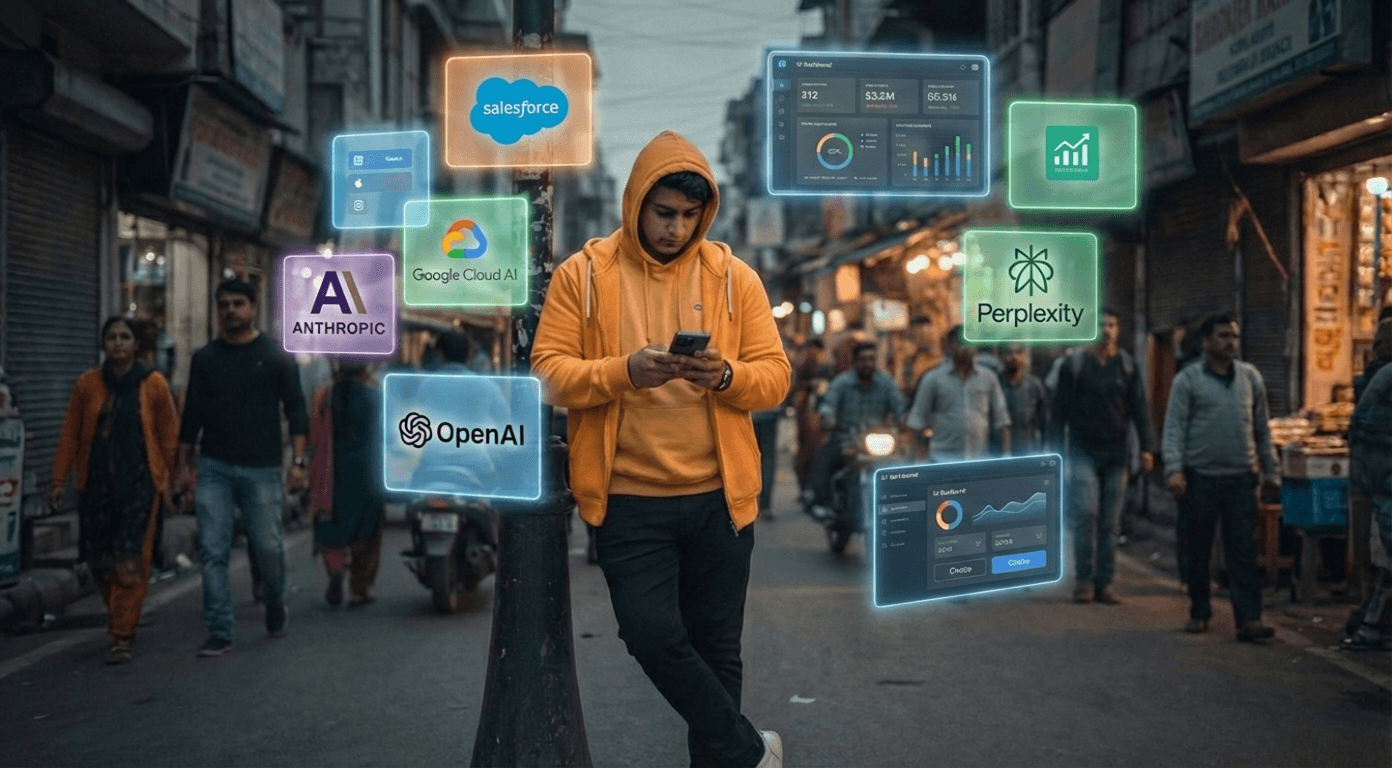
Welcome back to Venture Logbook. The personal console war is heating up. ChatGPT, Gemini, Anthropic, Perplexity are all fighting for consumer AI dominance. Today in Trend Spotlight, we analyze the shifting market dynamics, Google's unique full-stack position, and what the cloud wars can teach us about who wins consumer AI. In Startup Unboxed, we meet an EduTech founder navigating the brutal reality of big tech feature launches. We'll also explain "CLI" in our Tech Dictionary, all in a 6-minute read.
Trend Spotlight
This week, everyone's talking about Clawdbot (later renamed Moltbot). It got me thinking: who will actually win the consumer AI agent race?
I thought ChatGPT's dominance in 2C AI was permanent. That changed when Google Gemini kept shipping their vibe coding ecosystem. Not just better models, but a canvas that makes coding accessible. Anyone can build and interact with frontends now.
Let's look at the numbers. According to Similarweb, ChatGPT's web traffic share fell from 86.7% twelve months ago to 64.5% in early January 2026. It's still on top, but the slide is real. At the same time, Gemini crossed 20% market share.
Anthropic is keeping pace. Their Claude Code had strong coding and agent orchestration from day one, turning it into a hidden champion. It started as a developer favorite, no question. But once the ecosystem pieces came together (MCP, Skills, Claude in Chrome), Anthropic pushed out Claude Cowork, extending Claude Code from dev tools to everyday tasks like organizing documents, generating reports, managing folders.
Plus there's Perplexity, Manus merging into Meta's world, and xAI bridging the physical layer. The personal console war has officially begun.
I've used four of these services personally, skipping Meta and xAI. Out of those four, Perplexity is different. It's not built from the foundation model layer up. They have Sonar, but at least for me, that's not the draw.
Watching OpenAI, Gemini, and Anthropic compete at the foundation model layer reminds me of the old cloud market share wars. AWS entered early compared to Azure and Google, and held the cloud throne for years. That's exactly where Anthropic sits with coding models right now. My friends in the Bay Area can't name a single developer not using their models.
Azure has been the perennial number two, recognized for Microsoft's full enterprise stack and excellent real-time support. OpenAI feels similar. Maybe corporate culture does follow investment after all.
Google keeps chasing Azure and throws generous cloud credits at startups. But in the cloud era over the past ten-plus years, it's rarely been the go-to option for dev teams, not even the backup. This time is different though. In this foundation model to application battle, Google appears to be the only player with every critical piece in place.

Google owns the entire AI stack. TPUs, infrastructure, foundation models (world models included), applications, everything.
With all those apps tied together (Gmail, Maps, YouTube), could Google take over the personal console war and become the super app everyone uses?
Startup Unboxed #5
Today's unboxing features another solo founder. Before he reached out to me, he had several side projects going. I remember our first meeting lasted over four hours. From his projects all the way back to his life vision, I could see his passion for EduTech throughout.
He's building a notes app aimed at STEM students, with heavy optimization for mathematical expressions. (I feel this. As someone who loves math, Notion was never an option for me either.)
He pointed out that going solo, speed becomes the biggest bottleneck. He's actively looking for a co-founder, but as we both agreed: "better alone than with the wrong person" (a well-known Chinese idiom, usually about dating).
However, the familiar story of unicorns (or big tech) killing startups with a single feature launch happens all the time. After OpenAI acquired a similar service last year, they just announced Prism a few days ago—a LaTeX-native scientific writing and collaboration workspace.
He said: "It's almost exactly what we built. I pivoted immediately."
I personally love EduTech products. My first startup job was even in EduTech. But I also know the challenges of this sector.
Education sits in this weird space between B2B and B2G. You're selling to institutions and dealing with government-style processes, but your actual users are consumers. It's a uniquely tough market.
Right now, Google owns education and no one's even close (maybe we can thank pandemic-era remote learning for that?). In the global LMS market by organizational adoption, Google Classroom sits at roughly 9% (around 9.36% in 2024 by some measures). Google Workspace for Education reaches over 150 million students and educators in 230+ countries.
In a market with drawn-out POCs, endless sales cycles, and budgets dictated by policy, is getting acquired the only way out for startups?
🖌 Startup Unboxed is a series where I meet startups, journal the takeaways, and share my thoughts.
CLI ( Command-Line Interface)
A way to control computers and programs by typing commands, not by clicking through menus and buttons in a graphical interface (GUI).
If you lived through the TV era, you memorized channel numbers and just pressed "8" to jump to Channel 8. CLI works the same way: you type the full command and the computer jumps to the result, no clicking through menus.
A better comparison: typing =SUM(A1:A10) in Excel to auto-calculate instead of adding 10 numbers by hand. CLI is giving your computer a formula—a single command can execute 100 repetitive tasks.
Explaining to Grandma: CLI is like "speaking a secret code to your computer"—you type the command name, add parameters, and follow the rules to make it work, instead of hunting around with a mouse.
🧠 Tech Dictionary helps you decode common tech terms so clearly, even your grandma would get it. Quickly find out what matters & why. So you're never lost in the tech talk.